

Introduction: Safha Technologies & the Future of Digital Excellence in Saudi Arabia
In today’s rapidly evolving digital landscape, global brands cannot afford to rely on one-size-fits-all strategies—especially when entering dynamic and fast-growing markets like Saudi Arabia. As we move closer to 2030, the Kingdom is transforming into a global digital powerhouse, driven by Vision 2030, rising internet penetration, and a tech-savvy population.
Safha Technologies stands at the forefront of this transformation. As a professional software and IT company, Safha Technologies has helped businesses adapt, localize, and thrive in Saudi Arabia’s unique digital ecosystem. With deep expertise in web development, localization, AI-driven platforms, and enterprise solutions, Safha understands what it truly takes to succeed in the Saudi market.
This article explores why global brands need a different web strategy for Saudi Arabia in 2030—and why failing to adapt could mean missing one of the most lucrative opportunities in the Middle East.
The Problem: Why Global Web Strategies Fail in Saudi Arabia
Many global brands enter Saudi Arabia with a standard global website strategy. At first glance, this seems efficient. But in reality, it often leads to:
- Poor user engagement
- Low conversion rates
- Cultural disconnect
- SEO underperformance
Key Challenges:
- Language mismatch: Saudi Arabia is an Arabic-first market.
- Cultural misalignment: Local culture differs significantly from Western culture.
- Payment and logistics differences: Local preferences and infrastructure are unique.
- Mobile-first behavior: Saudi users primarily use mobile devices.
- Government regulations: Legal and policy requirements must be adhered to.
This is exactly why a global web strategy for Saudi Arabia in 2030 is not a question—it’s a necessity.
Understanding the Saudi Digital Landscape in 2030
A Rapidly Growing Digital Economy
Saudi Arabia is not just growing—it’s transforming:
- Internet penetration: Over 98% of the population is online.
- Smartphone usage: Among the highest globally.
- E-commerce growth: Expected to exceed $50 billion by 2030.
- Digital payments: Rapidly replacing cash in transactions.
Vision 2030 Impact:
Saudi Vision 2030 is driving:
- Digital transformation across industries.
- Smart cities like NEOM.
- Increased foreign investment.
- A thriving startup ecosystem.
This means global brands must rethink their approach completely. A global strategy that works in other regions may not be as effective in Saudi Arabia. There’s a growing need for digital solutions tailored to local contexts, and global brands must embrace this shift to stay relevant in the Kingdom.
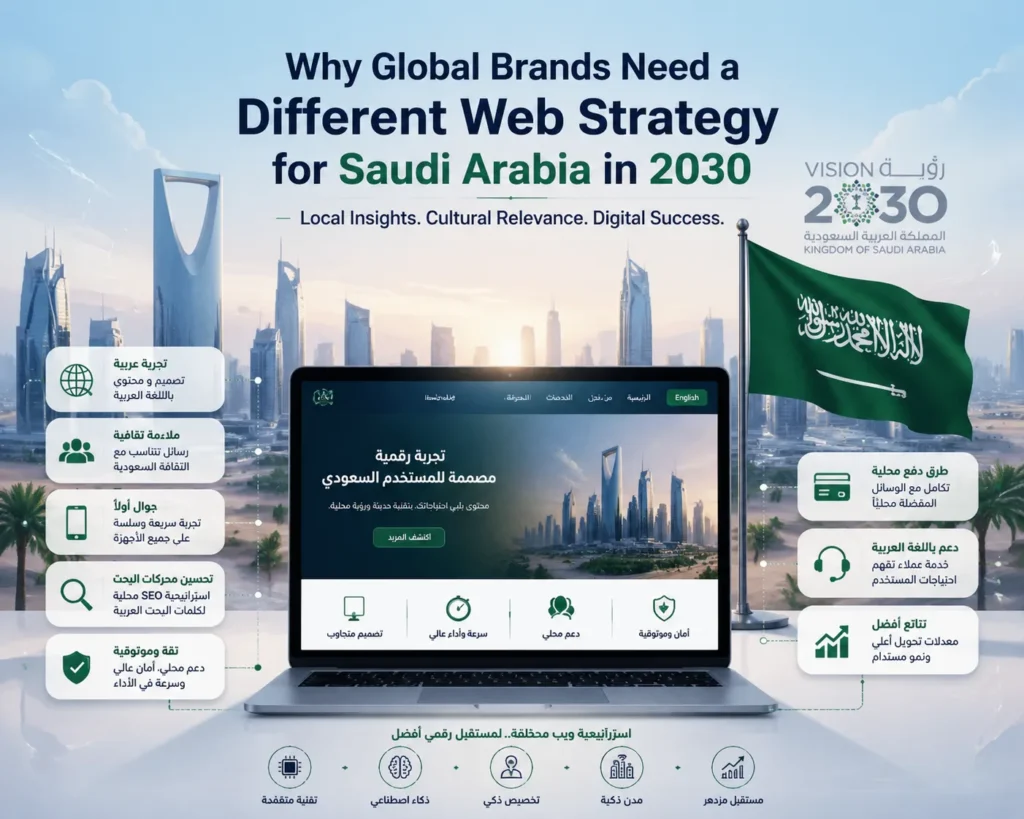
Why Global Brands Need a Different Web Strategy for Saudi Arabia in 2030?
1. Arabic-First Experience is Non-Negotiable
Saudi users prefer Arabic—not just translated content, but culturally adapted content.
What This Means:
- Full Arabic UI/UX
- Right-to-left (RTL) design
- Localized tone and messaging
Example:
A global e-commerce brand increased conversions by 70% after implementing Arabic-first UX, showing that localization can directly impact user behavior and business success.
2. Cultural Relevance Drives Engagement
Saudi Arabia has unique cultural values. Ignoring them can damage brand perception.
Key Cultural Considerations:
- Modesty in visuals: Avoid overly revealing imagery.
- Family-oriented messaging: Highlight family values and community.
- Religious sensitivity: Acknowledge and respect Islamic practices.
- Local holidays (Ramadan, Eid): Tailor promotions and content to align with local festivals and traditions.
Brands that do not respect these cultural nuances risk alienating potential customers.
3. Mobile-First is Mandatory
Saudi Arabia is a mobile-dominant market, and a mobile-first approach is essential.
Stats:
- 90%+ of users access websites on mobile devices.
- Mobile commerce dominates online sales.
Strategy Must Include:
- Fast-loading mobile pages.
- Progressive Web Apps (PWAs) for smooth user experiences.
- Simplified navigation for easy browsing on smaller screens.
Local SEO is Completely Different
SEO in Saudi Arabia differs from global SEO. Brands must optimize for local search behaviors and search engines like Google, as well as regional platforms.
Key Differences:
- Arabic keyword research: Focus on transactional Arabic keywords.
- Local search intent: Incorporate keywords like “Riyadh” or “Jeddah”.
- Regional search engines: Consider platforms like Google.sa alongside global search engines.
Example Keywords:
- Arabic transactional phrases such as “اشتري الآن” (buy now).
- Location-based searches for major cities.
Global SEO strategies that rely solely on English content will not perform well in the Saudi market.
4. Payment Preferences Are Unique
Global brands often fail because they don’t adapt payment systems to local preferences.
Popular Payment Methods:
- Mada: A Saudi-specific payment network.
- STC Pay: A mobile wallet for Saudi consumers.
- Apple Pay: Popular for quick, secure payments.
- Cash on Delivery (still relevant): Many customers in Saudi Arabia prefer this method, particularly for e-commerce.
Brands must integrate these local payment methods into their websites to improve conversions and enhance user experience.
5. Trust & Credibility Matter More
Saudi consumers value trust deeply. Building trust requires more than just offering a quality product—it’s about transparency, reliability, and a strong local presence.
Ways to Build Trust:
- Local hosting: Hosting websites on Saudi servers can improve speed and signal trust.
- Arabic customer support: Offering support in the local language increases customer confidence.
- Clear policies: Easy-to-understand return policies and terms of service.
- Social proof: Positive reviews from local customers are crucial for brand credibility.
Deep Dive: Web Strategy Components for Saudi Arabia
Localization vs Translation
Translation alone is insufficient. True localization involves adapting content to suit the cultural nuances of Saudi Arabia. This includes not only language but also the tone, imagery, and local idioms that resonate with Saudi consumers.
Localization Includes:
- Cultural adaptation: Ensure the visuals, tone, and message align with local preferences.
- Local idioms and expressions: Use terms and phrases that are familiar to Saudis.
- Region-specific offers: Tailor them to the local economy, festivals, and consumer habits.
UX/UI Design for Saudi Users
Design principles for Saudi users should reflect the country’s preferences, including clean aesthetics, premium looks, and intuitive navigation.
Key Design Principles:
- Arabic typography: Ensure that text flows naturally from right to left.
- High contrast visuals: Create designs with high visibility for mobile users.
- Clean aesthetics: Opt for a minimalist, high-end look that appeals to Saudi consumers’ tastes.
- Easy navigation: Simple, streamlined navigation for mobile users.
Performance Optimization
Saudi users expect speed. To meet their expectations, global brands must optimize their websites for performance.
Must-Haves for Optimization:
- CDN for the Middle East: Use a content delivery network to ensure fast page loading times across the region.
- Optimized images: Reduce image size without compromising on quality.
- Minimal scripts: Eliminate unnecessary scripts to improve page load times.
Content Strategy for Saudi Arabia
Content must be engaging, informative, and tailored to Saudi consumers.
Content Types That Work:
- Educational blogs: Offer valuable insights and helpful tips.
- Video content: Localized Arabic video content is crucial.
- Influencer collaborations: Partner with local influencers with strong followings.
Real-World Use Cases
Case Study 1: E-commerce Brand Expansion
A global fashion brand entered Saudi Arabia through its global website strategy but saw a high bounce rate and low conversion rates. After implementing localization—focusing on Arabic-first UX, culturally adapted visuals, and local payment methods—the brand saw a:
- 120% sales increase
- 80% engagement increase
This shows the direct impact that localization and a Saudi-specific strategy can have on business performance.
Case Study 2: SaaS Company
A global SaaS company localized its Arabic dashboard and offered local customer support in Saudi Arabia. As a result, the company experienced:
- 3x user retention
- Higher enterprise adoption
Benefits of a Saudi-Specific Web Strategy
- Higher conversion rates: Tailoring your website to Saudi preferences increases sales and engagement.
- Stronger brand loyalty: When customers feel that your brand understands their needs, they are more likely to remain loyal.
- Better SEO rankings: Local SEO optimization can improve your rankings on Google.sa and regional search engines.
- Increased trust: Transparency and local support build consumer confidence.
- Competitive advantage: Standing out in a competitive market is easier with a tailored strategy.
Comparison: Global vs Saudi Web Strategy
| Factor | Global Strategy | Saudi Strategy |
|---|---|---|
| Language | English-first | Arabic-first |
| UX | Universal | Culturally adapted |
| Payments | Global methods | Local methods |
| SEO | Generic | Localized |
| Content | Standard | Cultural |
Expert Insights from Safha Technologies
At Safha Technologies, we’ve observed a clear pattern:
“Brands that localize deeply outperform those that simply translate.”
Top Recommendations:
- Invest in Arabic UX early.
- Use local hosting for better site performance.
- Partner with local experts to navigate cultural nuances.
- Build trust through transparency and customer support.
Future Trends: Saudi Arabia in 2030
- AI-Driven Personalization: Websites will adapt dynamically to user behavior.
- Voice Search in Arabic: Optimizing for voice queries will become crucial.
- Super Apps Integration: Platforms like STC Pay and other apps will play a key role.
- Hyper-Localization: Content tailored to city-level preferences.
- Smart City Integration: Web platforms will be connected to IoT environments in smart cities.
Why Ignoring This Web Strategy is Risky?
Failing to adapt to the Saudi digital landscape means:
- Losing market share
- Poor brand perception
- Low ROI
- Missed opportunities
Conclusion
The digital future of Saudi Arabia is bright, fast-moving, and highly competitive. Global brands that want to succeed must understand one critical truth:
Why Global Brands Need a Different Web Strategy for Saudi Arabia in 2030 is not optional—it’s essential.
From localization to mobile-first design, from cultural sensitivity to payment adaptation, every element must be tailored to the Saudi market. By doing so, global brands can tap into the immense potential of Saudi Arabia’s digital economy and thrive in one of the world’s most lucrative markets.
Why Global Brands Need a Different Web Strategy for Saudi Arabia in 2030?
Because Saudi Arabia has unique cultural, linguistic, and digital behaviors that require tailored strategies.
Is Arabic content necessary for Saudi users?
Yes, Arabic-first content significantly improves engagement and conversions.
What are the key SEO differences in Saudi Arabia?
Arabic keywords, local intent, and region-specific optimization are crucial.
Which payment methods are popular in Saudi Arabia?
Mada, STC Pay, Apple Pay, and Cash on Delivery.
How can global brands build trust in Saudi Arabia?
Through localization, transparency, and local customer support.